A family memory box becomes useful when someone can tell what is inside without already knowing the story. Begin with a small set of objects and a few clear labels, then let the collection grow slowly.
Set a boundary for the box
Choose one person, one household, one period or one occasion as your focus. “Our first home” is easier to collect than “every family memory.” Use a sturdy box with a lid and enough room for flat papers. Keep it in a stable, dry part of the home rather than an attic, basement or garage. Avoid squeezing delicate paper between heavy objects.
Decide what belongs inside: a recipe written by a grandparent, a concert ticket, one child's drawing from each year, a letter, or a few photographs. If an object needs to be used frequently, photograph it for the box instead of hiding it away.
Label what the object cannot say
On a separate card, write who, what, where, approximately when and why you kept it. If the date is uncertain, say so. “Summer after the move, probably 2018” is more honest and useful than a confident guess. Ask relatives for the stories while they are available; record their wording and note who told you.
Include context without exposing private information. A scanned letter may be suitable to share with siblings, while a medical record or an intimate note may need a more private place.
Handle photographs gently
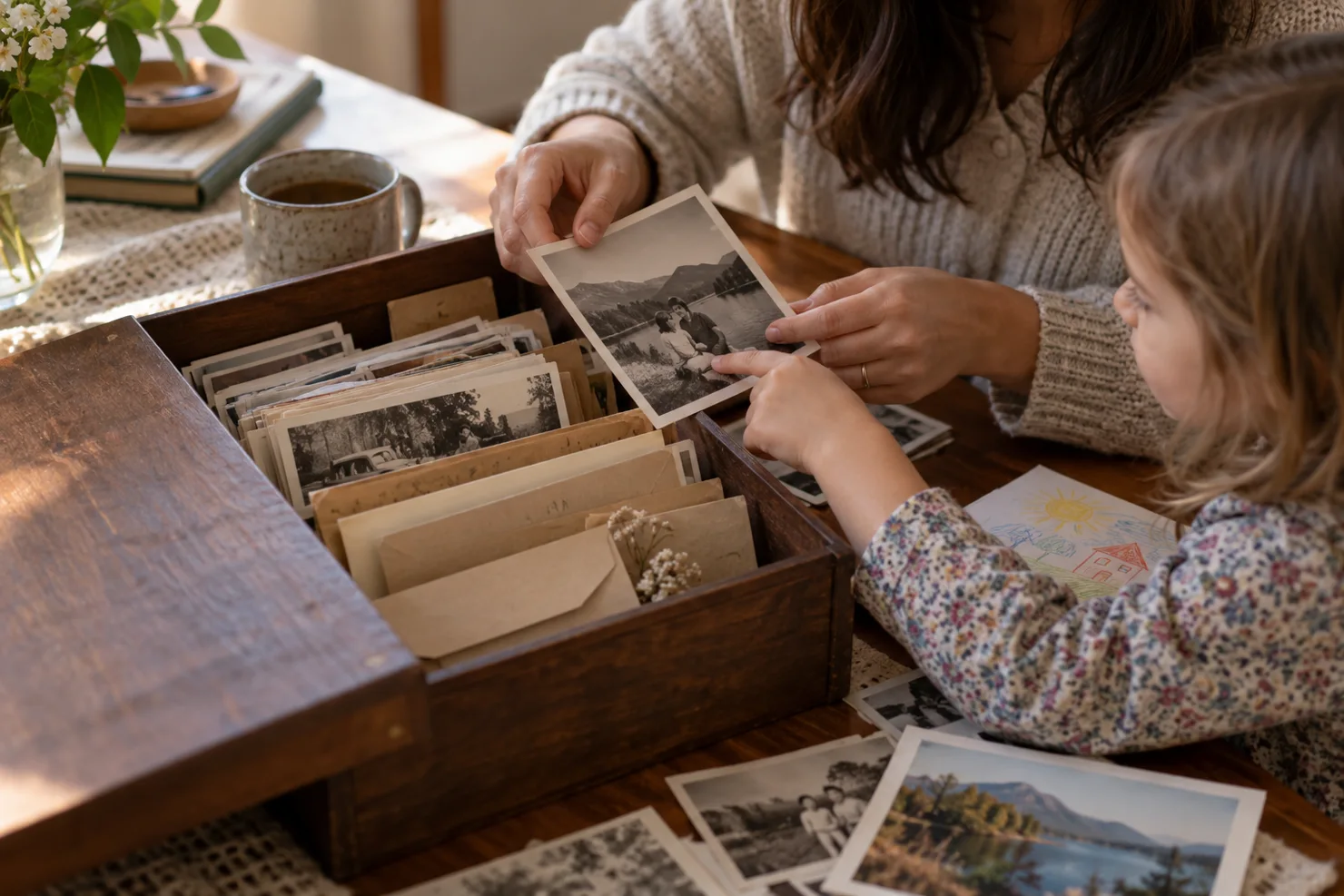
Old prints deserve care. Handle them with clean, dry hands and store them in photo-safe enclosures rather than sticking them to paper with household glue. The Library of Congress’s photograph care guide explains suitable storage approaches and warns against adhesive tape on photographs. For fragile or valuable originals, seek specialist advice before attempting repairs.
Make digital copies of irreplaceable images and store them in more than one place. Give files useful names such as “grandma-kitchen-1970s-approx.jpg” and add the source of the estimate. A scan preserves access; it does not make the physical original expendable.
Let children participate
Ask a child to choose one drawing, ticket or photograph each season and explain the choice. Write down their words on a card. A modest recurring practice tells more about growing up than a bag of unsorted worksheets. Let them know some things can be enjoyed and then recycled without guilt.
For a shared family box, invite each person to contribute an item and a short explanation. Do not press someone to share a memory they would rather keep private. The aim is connection, not an exhaustive record.
Use a ten-minute sorting session
- Gather one small pile rather than emptying every drawer.
- Choose three items with a clear story.
- Write labels on separate paper.
- Place copies or originals in suitable sleeves.
- Photograph the contents and close the box.
Repeat when it feels enjoyable. A box that is small and understandable is better than a sprawling project no one can maintain.
Share without giving away the only copy
For birthdays or reunions, make a small album of reproductions and captions. If the recipient loves display pieces, a single photo or illustrated print may make sense; compare format and size before ordering. For a person who wants stories more than objects, read the notes together over a meal. The memory box succeeds when the stories remain accessible to the people who care about them.
Decide who can access the collection
A family box can include joyful and complicated stories. Before sharing it widely, ask whose letters, portraits or documents it contains. Someone may be happy for close relatives to read a story but uncomfortable with a public social media post. Set a simple boundary: who keeps the physical box, who may borrow it and whether scans can be shared. Write this down if several households are involved.
If you find a document about another person's private life, do not assume that age makes it public. Ask a trusted relative or keep it separate until you understand the context. Respect matters as much as preservation.
Use copies for display and storytelling
A high-quality scan can be printed for a reunion table or placed in a child's school project while the original remains protected. Note the source on the back of a separate paper label or in a digital filename. Avoid writing directly on the front of a photograph. If you photograph a fragile item instead of scanning it, use soft even light, keep the camera parallel to the paper and capture both sides if the back contains information.
For digital files, make a simple folder structure by person or event. Do not build a complex archive system you will abandon. A clear filename and a short note about uncertainty are enough to help the next person understand what they are looking at.
Make an index before the box fills
Number a few envelopes or sleeves and keep a one-page list describing their contents. For example, “Envelope 3: three photographs from the first apartment; names on separate card.” An index saves people from repeatedly handling fragile pieces. It also helps you notice duplicate images or missing stories.
Revisit the box once or twice a year, not every weekend. Remove any materials that are damaging nearby items. If a photograph is stuck, brittle, moldy or otherwise fragile, do not force it apart; seek qualified preservation guidance.
Turn storage into connection
Invite an older relative to identify one picture over tea, or ask a child what they want to remember about this year. Capture the words in their voice. The box should prompt conversations, not become a perfect museum project. One labeled photograph and the story beside it are already a meaningful start.
What to do with duplicates
Several copies of the same picture can be useful if relatives want one, but they do not all need to live in the main box. Keep the best-preserved copy with its label and note where the others are. If the prints differ, inspect the backs for names or dates before deciding which to keep. A duplicate with a handwritten note may tell a separate story.
When you share scans, keep the original filename or a small index that connects copies to the physical items. Otherwise an appealing digital collection can lose its source information in a few years. A modest, traceable system is easier for the next family member to continue.
You can also include a small question card in the box: “Who taught you this recipe?” or “What happened just before this picture?” Ask one question at a time when relatives are willing to talk. Record uncertainty rather than smoothing it away. Over the years, several short answers can make the collection richer than a perfectly arranged album without context. The box is a place to begin a conversation, and a simple label helps that conversation travel beyond the people who first filled it.
Take one idea that fits the person in front of you. The small detail you can act on today is usually the best place to start.